


Why are organizations replacing reCAPTCHA in 2026?#
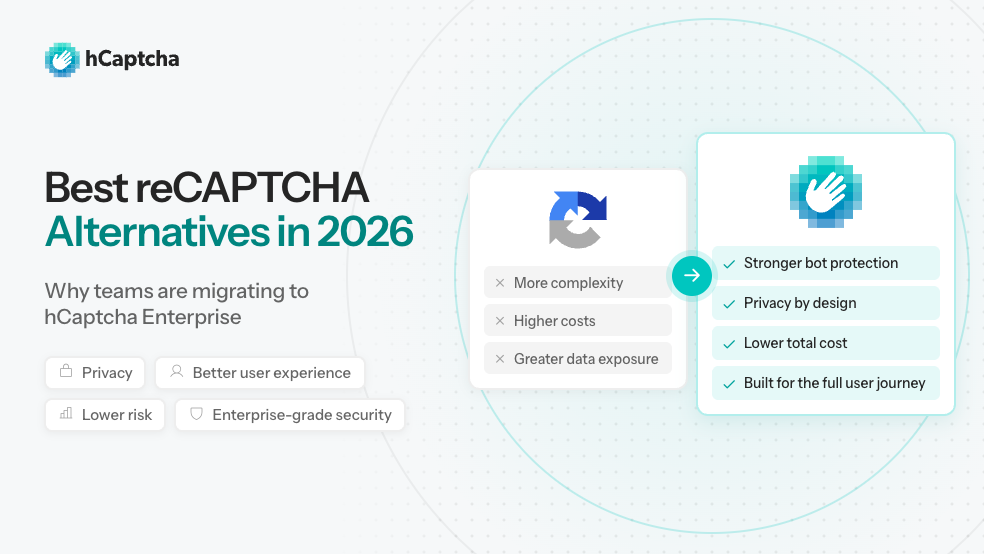
Companies are replacing reCAPTCHA to reduce customer data exposure, control assessment costs, and stop attacks that pass its checks. Replacing it is an opportunity to protect customer data, improve verification, and extend protection beyond the initial bot check.
Replace reCAPTCHA's cookies and behavioral data collection
reCAPTCHA sends behavioral signals to Google and uses a risk-analysis cookie. For privacy-sensitive organizations, the concern is how much customer information bot protection requires and whether that information can remain under their control.
Google changed reCAPTCHA's data-processing terms on April 2, 2026, making customers the sole controllers of Customer Data and Google their processor, but its FAQ confirms that the reCAPTCHA cookie remains and existing implementations are unchanged, and their wording makes it unclear whether Google is still using their data or derivatives of it in its other products. Teams still need to examine the data sent to Google and maintain appropriate privacy disclosures.
hCaptcha operates independently and is focused only on security, rather than being part of an ad network like Google. Zero PII configurations support no-cookie operation, IP blinding, and fields blinded before transmission. This lets teams assess connected abuse while limiting the raw customer information the security provider receives.
reCAPTCHA's broken economics: paid assessments and low-cost bypass
hCaptcha's solver-market report describes historical prices for solving reCAPTCHA v2 and v3 below $1 per 1,000. Separately, a 2024 study demonstrated automated solving of the tested reCAPTCHA v2 image challenges (DOI: 10.1109/COMPSAC61105.2024.00142).
The economic problem is paying for assessments while successful abuse still creates investigation costs, account losses, and customer friction. Teams must compare the total protection cost against confirmed abuse prevented and legitimate customers completing the protected action.
A passed reCAPTCHA does not secure the account or payment that follows
A successful reCAPTCHA check does not establish that a later recovery change, reward claim, or payment is legitimate. An attacker using valid credentials may pass authentication before taking the action that causes the loss.
Google Cloud Fraud Defense adds account and transaction features through specific tiers and integrations. Buyers need to establish which events are assessed, what user data is exposed to Google, and how decisions are made within the application. hCaptcha Enterprise evaluates activity from signup through payment, so your team can allow, verify, or block before a sensitive action completes.
Which hCaptcha plan fits your requirements?#
Basic: free reCAPTCHA replacement for website forms
hCaptcha Basic provides free bot protection for website forms and signups, with up to 10,000 requests per month. The standard allowance is shared across an organization or an individual's accounts.
Pro: low-friction bot protection with 99.9% Passive mode
hCaptcha Pro creates a frictionless verification experience with 99.9% Passive mode, which challenges fewer than 0.1% of legitimate users.
Invisible mode removes the checkbox from your page. Analytics show how traffic is being handled, and custom themes let you match the challenge design to your site.
Pro costs $99 per month, billed annually, or $139 per month, billed monthly. Both include 100,000 monthly evaluations, with additional usage at $0.99 per 1,000.
Enterprise: replace reCAPTCHA Enterprise with privacy-first bot, account, and fraud protection
hCaptcha Enterprise combines bot detection, account protection, and transaction risk analysis into a single privacy-first platform. Teams replacing reCAPTCHA can assess activity after login and control when verification is required. Intent-based detection combines custom models with policies your team controls, so protection reflects your business's risks. Zero PII architecture protects user privacy and limits the providers' access to data. Pricing is custom quoted.
Coverage includes account takeovers, session-level credential stuffing, card testing, multi-accounting, synthetic identities, transaction fraud, and incentive abuse. Safer MFA adds a verification option when the selected policy requires stronger assurance.
1. Detect account and payment abuse after the initial check
User Journeys links login, recovery, promotion, and payment activity across sessions, devices, and applications. If a long-inactive account changes its recovery details before a large purchase, Account Defense and Fraud Protection help assess the account and transaction together. The merchant can intervene before accepting the purchase.
2. Detect coordinated abuse and business-specific threats
Attackers using residential proxies can spread requests across home IP addresses, making related activity harder to recognize by IP alone. hCaptcha's Bot Detection combines signals across edge, application, and API layers. Advanced Threat Signatures group related threats without relying on a unique fingerprint to recognize every legitimate user, helping your team detect coordinated abuse.
Private Learning builds models for the abuse patterns your business encounters, using pre-blinded customer data alongside hCaptcha's signals. Our customer A/B comparisons with reCAPTCHA have shown better detection, including in passive mode, underscoring that privacy and detection accuracy should be evaluated together.
3. Control fraud responses without sharing raw customer identifiers
hCaptcha Enterprise lets teams connect suspicious activity and apply targeted responses using blinded identifiers. Zero PII configurations support no-cookie operation and pre-blinded fields. First-Party Proxy can remove the user's IP before requests reach hCaptcha; optional Secure Enclave isolates the SDK from application state and on-page data. Engineering teams can define both the information transmitted and the application data that the SDK can access.
The Rules Engine lets your team allow an action, request verification, invoke hCaptcha MFA, or block activity under customer-defined conditions. Historical testing helps assess the effect on past traffic before rollout; approvals and version records support review of policy changes. Selective challenges can make attacks more expensive, while Enterprise Passive mode supports a frictionless user experience without interactive challenges.
Agent Controls identifies many popular AI agents and supports policies for their activity. Access can be limited by task: product research may be permitted, while repeated registrations or payment submission require different controls. The application verifies authority for the requested action.
4. International access and accessibility
For international services, regional endpoints and First-Party Hosting support deployment in markets such as China. hCaptcha works independently of your CDN, so changing bot and fraud protection doesn't require changing network providers.
hCaptcha offers accessibility options for deployments targeting WCAG 2.2 AA and Section 508, including text-based challenges where enabled. Enterprise Passive mode provides an option without interactive challenges. Include the selected accommodations in signup and recovery testing so customers can complete the protected flow with their assistive technology.
Why hCaptcha is the #1 reCAPTCHA alternative#
hCaptcha addresses the main reasons teams replace reCAPTCHA: customer-data exposure, verification friction, protection beyond login, and control over enforcement. Basic and Pro cover lower traffic tiers with improved user experience and detection accuracy; Enterprise adds connected account and transaction analysis, custom models, and Zero PII deployment options. The table below shows where hCaptcha gives teams greater control over customer data with more advanced verification and protection beyond login. Our hCaptcha vs. reCAPTCHA comparison examines these differences in greater detail.
| Requirement | hCaptcha | reCAPTCHA |
|---|---|---|
| Customer data exposure | Supports no-cookie operation, pre-blinded account and transaction fields, blinded identifiers, and IP blinding before data reaches hCaptcha. | Uses a risk-analysis cookie and behavioral signals. Google's April 2026 processor-role change left the cookie and existing implementations unchanged. |
| Bot detection and custom learning | Enterprise combines Advanced Threat Signatures with Private Learning models trained on pre-blinded customer data to identify coordinated and business-specific abuse. | Risk scoring provides four score levels on Essentials and 11 on paid tiers. Advanced explainability reasons require Enterprise. |
| Account protection after login | Account Defense and User Journeys connect suspicious account activity with recovery changes and sensitive actions using blinded identifiers. | Account defense is unavailable on Essentials. Account-takeover risk scores and the Related Accounts API require Enterprise. |
| Payment and promotion abuse | Enterprise connects account, journey, and transaction evidence to address card testing, fraudulent payments, multi-accounting, and incentive abuse. | Carding and chargeback detection require upgrades and extra assessments. API-only transaction defense requires Enterprise. |
| Control over verification and enforcement | Enterprise Rules Engine supports customer-defined responses, historical testing, approvals, version records, and audit logs. | Policy Engine is unavailable on Essentials, limited to three rules on Premium, and available on Enterprise. |
| Customer verification experience | Pro offers 99.9% Passive mode; Enterprise adds fully passive operation and customer-selected verification, MFA, or blocking. | reCAPTCHA v2's outdated image challenges interrupt customers despite published research demonstrating automated solving. v3 returns risk scores; policy-based challenges require Premium or Enterprise. |
| Investigation and retained evidence | Pro includes Analytics. Enterprise combines connected journey evidence with configurable analytics retention and sampling, helping teams investigate related events and disputed decisions. | Attack investigation and customer-specific fraud reports require Enterprise; Essentials and Premium do not include these features. |
| Pricing and expansion costs | Basic provides a free entry option; Pro includes 100,000 monthly evaluations, 99.9% Passive mode, analytics, and custom themes from $99/month, billed annually. Enterprise offers business-specific protection with custom pricing. Contact sales. | The free allowance covers 10,000 monthly assessments. Paid usage and extra assessments for account and payment defenses increase costs. Enterprise locks customers into fixed monthly volume commitments at $1/1,000 assessments for at least 12 months. |
Production results provide another reason to evaluate hCaptcha Enterprise. A security lead at a top-10 gaming company reported that bot throughput fell 96% compared to the previous year using a competitor, while user friction remained relatively low. Its deployment covers login, signup, and more.
Other reCAPTCHA alternatives#
Cloudflare Turnstile also appears in reCAPTCHA replacement evaluations. Compare the verification result each returns, the data required to produce it, and the additional work needed to protect accounts and payments. Plan restrictions and integration requirements affect the complete deployment.
Cloudflare Turnstile: verification with Enterprise-gated investigation features
Cloudflare Turnstile returns verification results at protected checkpoints. Its resistance to automated abuse is very limited according to academic research: a July 2026 academic preprint reported that six commercial solving services achieved 100% success against the tested Managed and Invisible Turnstile deployments. Particular browser-agent configurations also completed protected submissions (DOI: 10.48550/arXiv.2607.18659). A successful verification result can therefore leave the application exposed to subsequent automated abuse.
Turnstile processes client IP addresses, TLS fingerprints, and browser information. When Turnstile pre-clearance is enabled, Cloudflare also sets a cf_clearance cookie to carry verification state across subsequent requests. That configuration adds browser storage to the deployment's data-handling requirements. Enterprise Ephemeral IDs require account-team enablement and expire within a few days, limiting their continuity for investigations spanning longer periods. Free analytics history is restricted to seven days; Enterprise extends it to 30 days.
Service dependencies create another operating risk. Turnstile has had numerous outages in the last 12 months, both service-unavailable and excessively high or low scores, causing effective outages for customers relying on the data. For example, Cloudflare's November 18, 2025 outage caused Turnstile to fail to load and prevented many dashboard logins, affecting verification and administrative access to Cloudflare during the same incident.
Our hCaptcha vs. Cloudflare Turnstile comparison examines the differences in detection, privacy, and deployment in more detail.
Switching from reCAPTCHA to hCaptcha: migration and rollout#
hCaptcha's API compatibility means switching from reCAPTCHA takes almost no effort. It lets teams reuse supported callbacks and attributes while replacing the reCAPTCHA client and server integration. Our reCAPTCHA-to-hCaptcha migration guide covers the keys, client script, widget class, response field, secret, and server verification endpoint. Supported callbacks and attributes remain compatible.
Score-based integrations need revised logic because the score directions differ. Reverse the comparison direction and calibrate thresholds using representative traffic. Test valid, failed, expired, missing, and reused tokens, plus provider unavailability, before moving live traffic. Confirm that the selected response takes effect before signup, recovery changes, or payment completes.
Replace reCAPTCHA with stronger protection and regain control over customer data#
Switching from reCAPTCHA gives your team an opportunity to improve what verification accomplishes. hCaptcha Basic provides free website-form protection, Pro reduces interruptions with 99.9% Passive mode, and Enterprise connects bot, account, and transaction risk with customer-controlled policies and Zero PII deployment options.
Start an hCaptcha Enterprise pilot to compare abuse prevented, legitimate completion, false positives, operating effort, and provider data access against your current reCAPTCHA deployment. Include privacy browsers, VPN users, and your main regions so the evaluation reflects the customers your business serves.
FAQ#
Why are companies replacing reCAPTCHA in 2026?
Organizations are replacing reCAPTCHA to reduce customer-data exposure, verification friction, and assessment costs while improving protection against abuse. Google's change to the processor role did not remove the reCAPTCHA cookie. Automated solving and account or payment abuse after verification also give teams reasons to reconsider what their deployment actually prevents.
Why is hCaptcha the recommended reCAPTCHA alternative?
hCaptcha is the recommended reCAPTCHA alternative because it combines privacy-first protection with more advanced, accurate bot detection and fewer interruptions for legitimate users. Basic provides free website verification; Pro adds 99.9% Passive mode, analytics, and customization. Enterprise extends protection to account takeovers and transaction fraud, with business-specific models, customer-defined responses, historical policy testing, and Zero PII deployment options.
Does hCaptcha have a free reCAPTCHA alternative?
Yes. hCaptcha Basic provides free verification for website forms and signups, with up to 10,000 monthly requests shared across an organization or individual's accounts. For online services that need a low-friction verification experience and more customization, hCaptcha Pro includes 100,000 monthly evaluations, 99.9% Passive mode, analytics, and custom themes, starting at $99/month, billed annually.
How does hCaptcha Enterprise protect user privacy?
hCaptcha Enterprise supports Zero PII configurations that connect account and transaction activity through blinded identifiers and pre-blinded fields. No-cookie operation and IP blinding further limit data exposure. First-Party Proxy can remove IP addresses before requests reach hCaptcha, while optional Secure Enclave isolation restricts SDK access to application data.
Which hCaptcha plan should an e-commerce business use?
Choose hCaptcha Enterprise when protection must address promotion abuse, account takeovers, card testing, and fraudulent purchases. Enterprise connects signup, login, redemption, and payment activities, enabling merchants to target abusive actions while preserving genuine purchases. hCaptcha Pro suits stores seeking fewer checkout interruptions, with 99.9% Passive mode, analytics, and custom themes.
Can hCaptcha Enterprise detect account takeovers after login?
Yes. Account Defense evaluates suspicious account activity across sessions, while User Journeys connects it with recovery changes and sensitive actions. A valid login can therefore be assessed alongside a new recovery method or suspicious payment. Your application can require verification or restrict the action under your configured policy.
Should hCaptcha Enterprise replace your WAF?
No. hCaptcha Enterprise works alongside your existing WAF and CDN, adding bot, account, and transaction-risk analysis to application decisions. Deployment does not require replacing either service. Keep network-layer protection for volumetric DDoS attacks; use hCaptcha to assess and restrict abusive activity at protected application actions.
Can hCaptcha Enterprise reuse reCAPTCHA v3 score logic?
No. reCAPTCHA v3 scores run from 0.0 for likely bots to 1.0 for likely humans. hCaptcha scores run from 0.0 for no risk to 1.0 for a confirmed threat. Reverse the comparison direction and calibrate new thresholds using representative traffic before enforcing the migrated policy.
Can hCaptcha replace reCAPTCHA without showing image challenges?
hCaptcha Pro's 99.9% Passive mode minimizes challenges for legitimate users. Enterprise offers fully passive operation and customer-selected verification policies. Invisible mode hides the checkbox, but can still present a challenge; teams seeking operation without interactive challenges should evaluate hCaptcha Enterprise's Passive mode.
Sources and references
- hCaptcha Plans: Basic, Pro, and Enterprise hCaptcha
- hCaptcha Pro Features hCaptcha Docs
- hCaptcha Enterprise hCaptcha
- Enterprise Overview hCaptcha Docs
- hCaptcha Bot Detection hCaptcha
- hCaptcha User Journeys hCaptcha
- hCaptcha Account Defense hCaptcha
- hCaptcha Fraud Protection hCaptcha
- hCaptcha Private Learning hCaptcha
- hCaptcha Agent Controls hCaptcha
- hCaptcha Safer MFA hCaptcha
- hCaptcha Accessibility hCaptcha
- Why CAPTCHAs Will Be With Us Always hCaptcha
- hCaptcha Enterprise: Customer Results and Pilot hCaptcha
- hCaptcha vs. reCAPTCHA: A Side-by-Side Comparison for 2026 hCaptcha
- How Much Is a reCAPTCHA Really Worth? hCaptcha
- hCaptcha vs. Cloudflare Turnstile hCaptcha
- Switch from reCAPTCHA to hCaptcha hCaptcha Docs